


NeuroArts Expansion Series
NeuroArts Expansion Series
Author: Joseph Stanek, Tour de Fierce Research, ORCiD: 0009-0003-9390-4809
The NeuroArts Expansion Series is a scholarly monograph sequence advancing a foundational argument: that artistic practice generates original knowledge, and that the field of NeuroArts cannot reach its investigative horizon without structural frameworks that recognize and incorporate that knowledge at the point of origination.
Across five essays, the series introduces named theoretical constructs — including Artist-Led Origination, Applied Aesthetic Contexts, Diachronic Aesthetic Knowledge, Reciprocal Embodied Literacy, and the ETUDE framework — that together propose a new research architecture for the next generation of arts-science inquiry. All essays are published open-access on Zenodo under CC BY 4.0 and indexed across major research platforms.
Theoretical Constructs Introduced in this Series
Construct | Abbreviation | Introduced In |
|---|---|---|
Artist-Led Origination* | ALO | Essays No. 01 & 03 |
Applied Aesthetic Contexts | AAC | Essay No. 02 |
Diachronic Aesthetic Knowledge | DAK | Essay No. 03 |
Reciprocal Embodied Literacy | REL | Essay No. 04 |
Empirical Tracking of Universal Development in Esthetics | ETUDE | Essay No. 05 |
*Artist-Led Origination operates through two named pathways: Artist-Initiated Inquiry and Practice-Led Inquiry, both introduced in Essays No. 01 and No. 03.
Each construct is defined within the essay in which it is introduced. Definitions are available in full within the open-access texts.

Essays in this Series
No. 01 — NeuroArts Expansion: A Framework for Artist-Led Inquiry in Applied Aesthetic Contexts
-
Published · March 2026
No. 02 — Applied Aesthetic Contexts: Environments That Generate What Laboratories Cannot
-
Published · March 2026
No. 03 — Artist-Led Origination: Before the Hypothesis
-
Published · March 2026
No. 04 — Reciprocal Embodied Literacy: The Epistemological Foundation of Artist-Scientist Collaboration in NeuroArts
-
Forthcoming · Deposit pending
No. 05 — ETUDE: The Longitudinal Infrastructure of the NeuroArts Expansion
-
Forthcoming · Deposit pending
Essay Overview: No. 01


NEUROARTS EXPANSION SERIES: ESSAY NO. 01
NeuroArts Expansion: A Framework for Artist-Led Inquiry in Applied Aesthetic Contexts
Author: Joseph Stanek
Series: NeuroArts Expansion Series
Essay: No. 01
This essay introduces the conceptual and methodological foundation of the NeuroArts Expansion Series, arguing that the field cannot reach its investigative horizon without research architectures that integrate artistic practice at the point of origination. It establishes the series' four core constructs — Artist-Led Origination, Applied Aesthetic Contexts, Reciprocal Embodied Literacy, and ETUDE — and positions practitioner expertise as a legitimate and necessary epistemological source for NeuroArts inquiry.
Essay Overview: No. 02
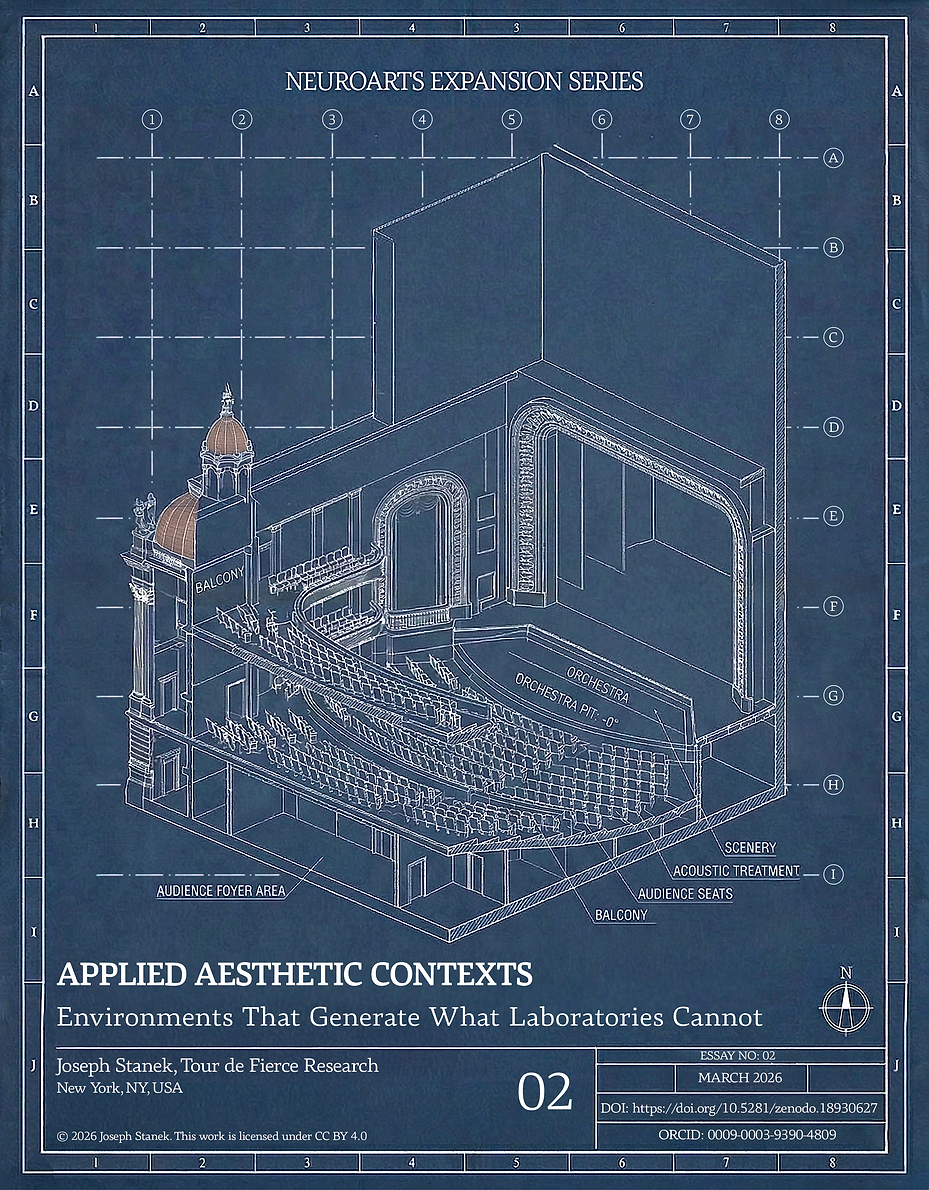
NEUROARTS EXPANSION SERIES: ESSAY NO. 02
Applied Aesthetic Contexts: Environments That Generate What Laboratories Cannot
Author: Joseph Stanek
Series: NeuroArts Expansion Series
Essay: No. 02
This essay formally introduces Applied Aesthetic Contexts — artistic environments in which aesthetic experiences unfold under genuine social, institutional, and cultural conditions. It argues that these environments are ecologically valid sites for NeuroArts inquiry, capable of generating aesthetic phenomena that no laboratory can reproduce, and establishes them as the evidentiary landscape within which Artist-Led Origination operates.
Essay Overview: No. 03
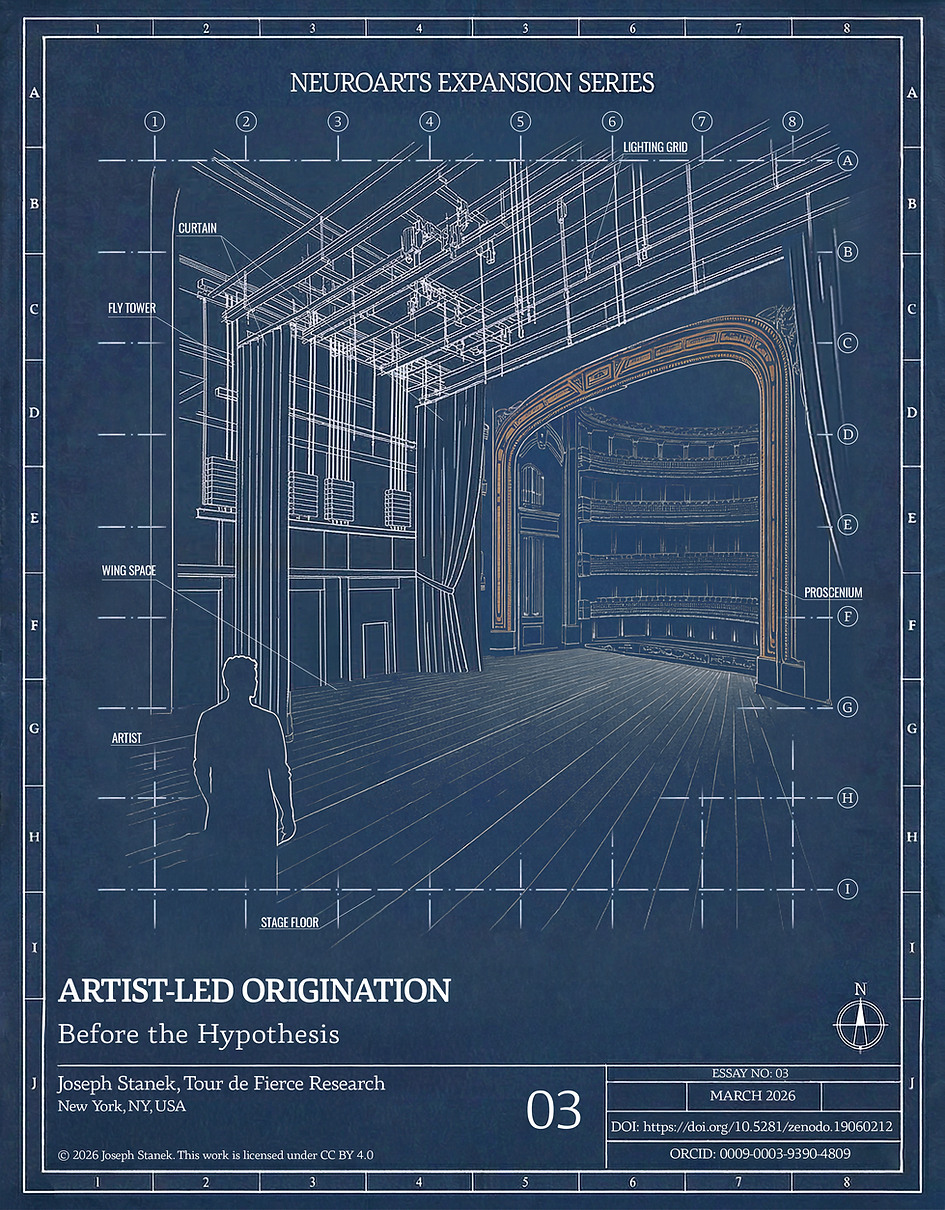

NEUROARTS EXPANSION SERIES: ESSAY NO. 03
Artist-Led Origination: Before the Hypothesis
Author: Joseph Stanek
Series: NeuroArts Expansion Series
Essay: No. 03
This essay advances Artist-Led Origination beyond its introduction as a structural access remedy, establishing it as a formal epistemological principle: research agendas may legitimately originate from the lived expertise of practitioners operating within Applied Aesthetic Contexts, because certain classes of aesthetic phenomena cannot enter the field's investigative purview through any other pathway. It also introduces Diachronic Aesthetic Knowledge — the practitioner's accumulated capacity to interpret aesthetic phenomena across time — as one of NeuroArts' most consequential and least utilized evidentiary resources.
Essay Overview: No. 04

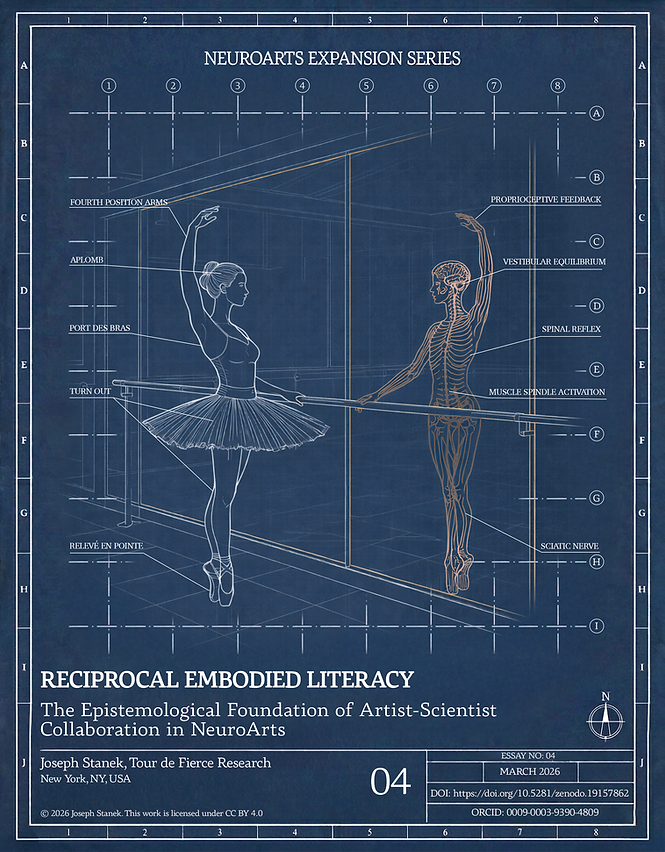
NEUROARTS EXPANSION SERIES: ESSAY NO. 04
Reciprocal Embodied Literacy: The Epistemological Foundation of Artist-Scientist Collaboration in NeuroArts
Author: Joseph Stanek
Series: NeuroArts Expansion Series
Essay: No. 04
This essay introduces Reciprocal Embodied Literacy as the experiential foundation required for productive arts-science collaboration — arguing that genuine interdisciplinary inquiry depends not on translation between disciplines, but on bidirectional embodied competence developed through sustained engagement with each other's practice environments. It repositions collaboration itself as a skill that must be cultivated, not assumed.
Forthcoming
Essay Overview: No. 05


NEUROARTS EXPANSION SERIES: ESSAY NO. 05
Empirical Tracking of Universal Development in Esthetics (ETUDE): The Longitudinal Infrastructure of the NeuroArts Expansion
Author: Joseph Stanek
Series: NeuroArts Expansion Series
Essay: No. 05
This essay introduces ETUDE — Empirical Tracking of Universal Development in Esthetics — as a proposed population-scale longitudinal measurement infrastructure for NeuroArts research. Grounded in life-course theory and Bronfenbrenner's ecological systems framework, ETUDE provides the methodological architecture through which the series' theoretical constructs become empirically operational across time, population, and aesthetic context.
Forthcoming
Predecessor Publication

FEATURED IN THE NEUROARTS RESOURCE CENTER LIBRARY
The Artist-Initiated Frontier: Structural Evolution and the ALO Framework in Neuroarts Research
Author: Joseph Stanek
Published prior to the formal launch of the NeuroArts Expansion Series, this preprint introduced the earliest iteration of Artist-Led Origination as a structural governance remedy for access asymmetries within NeuroArts funding infrastructure. The arguments developed here were subsequently expanded, refined, and repositioned within the broader epistemological architecture of the series. It is preserved here as an archival record of the construct's intellectual origins.
Tour de Fierce Research investigates the frontiers of vocal science, human expression, evolution, and emerging technologies within the entertainment industry. With a commitment to transparency, rigor, and creative accountability, our work examines how the human voice functions not only as a tool for performance, but as a primary mechanism for meaning-making, identity, and purpose in an increasingly mediated world.
